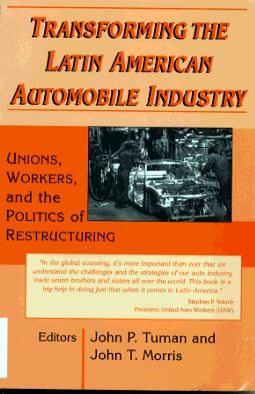
| This book presents an international comparison of transformations
underway in the Latin American automobile industry since the
liberalization movement of the 1980s through the prism of two axes. First
of all, the evolution of public policy and new production organizational
modes in the framework of a free market and regional integration are
examined. Next, an analysis centers on the introduction of flexible
production methods in work organization and worker relations, new ways of
mobilizing the workforce, the attitudes of unions, and salary compromises
achieved between unions, firms, and the State. Following a general
introduction, specific chapters are devoted to Argentina (Ana Maria
Catalano and Marta S. Novick), Brazil (Glauco Arbix and Iram
Jácome Rodrigues), Venezuela and the case of Renault (Mauricio
Cárdenas P.), Mexico (John T. Morris), in particular its old plants
(John P. Tuman), and finally Venezuela (Héctor Lucena). With regard
to these two axes, John Morris and John Tuman make several general
conclusions.
|
| Regional agreements stimulated exchange within each zone, Nafta,
Mercosur, and the Andin Group. These commercial regrou-pings demonstrate
the impact of free market exchange agreements and encourage
multinationals to adapt their production and regional redistribution
systems, at least as an initial step towards eventual globalization.
Foreign investments have centered on Mexico and Brazil, and to a
lesser extent on Argentina. These countries experienced a high growth
level in their production capacities, and as such constitute the main
poles of a regional production and distribution structure.
|
| New implantations in Mexico and Brazil avoided central industrial
centers and often built "green plants" surrounded by equipment
suppliers (often foreign) towards whom a great deal of activity is
often transferred so as to reduce salaries. This has given rise to a
number of entirely new automobile complexes. Faced with changes in work
organization, unions were less enthusiastic than managers and
politicians. According to each case involved, they either thwarted or
gave bad press to the spread of so-called "Japanese methods". In Mexico,
Argentina, and Brazil, worker agreement accepting new work organizations
was often linked to job level security guarantees or to future of salary
policy, especially to State responsibility in agreements established with
firms. When State authorities and employers refused to confirm these
guarantees, or failed to apply agreements, workers relied on strategies
of implementing immediate demands. In the final analysis, corporatist
links between unions and the State continue to play an important role
in the Latin American context.
|